Computational Consciousness Modeling
A rigorous framework implementing Allostatic Precision-Gated Ignition theory through computational models and experimental validation
Core Capabilities
Comprehensive computational toolkit for consciousness research
APGI Agent
Full implementation of the Allostatic Precision-Gated Ignition framework with dynamic threshold mechanisms, precision-weighted prediction errors, and somatic marker integration.
Phase Transitions
Somatic marker-based decision making with conscious vs unconscious processing modes and expected free energy calculations.
Experimental Framework
Standardized base classes for all experiments with automated data collection, analysis pipelines, and visualization tools.
Real-Time Analysis
Comprehensive data analysis utilities with threshold tracking, detection rate analysis, and performance metrics computation.
AI Benchmarking
Compare different agent architectures in survival environments. Test Random, Reactive, DQN, and APGI agents across multiple scenarios.
Multiple Interfaces
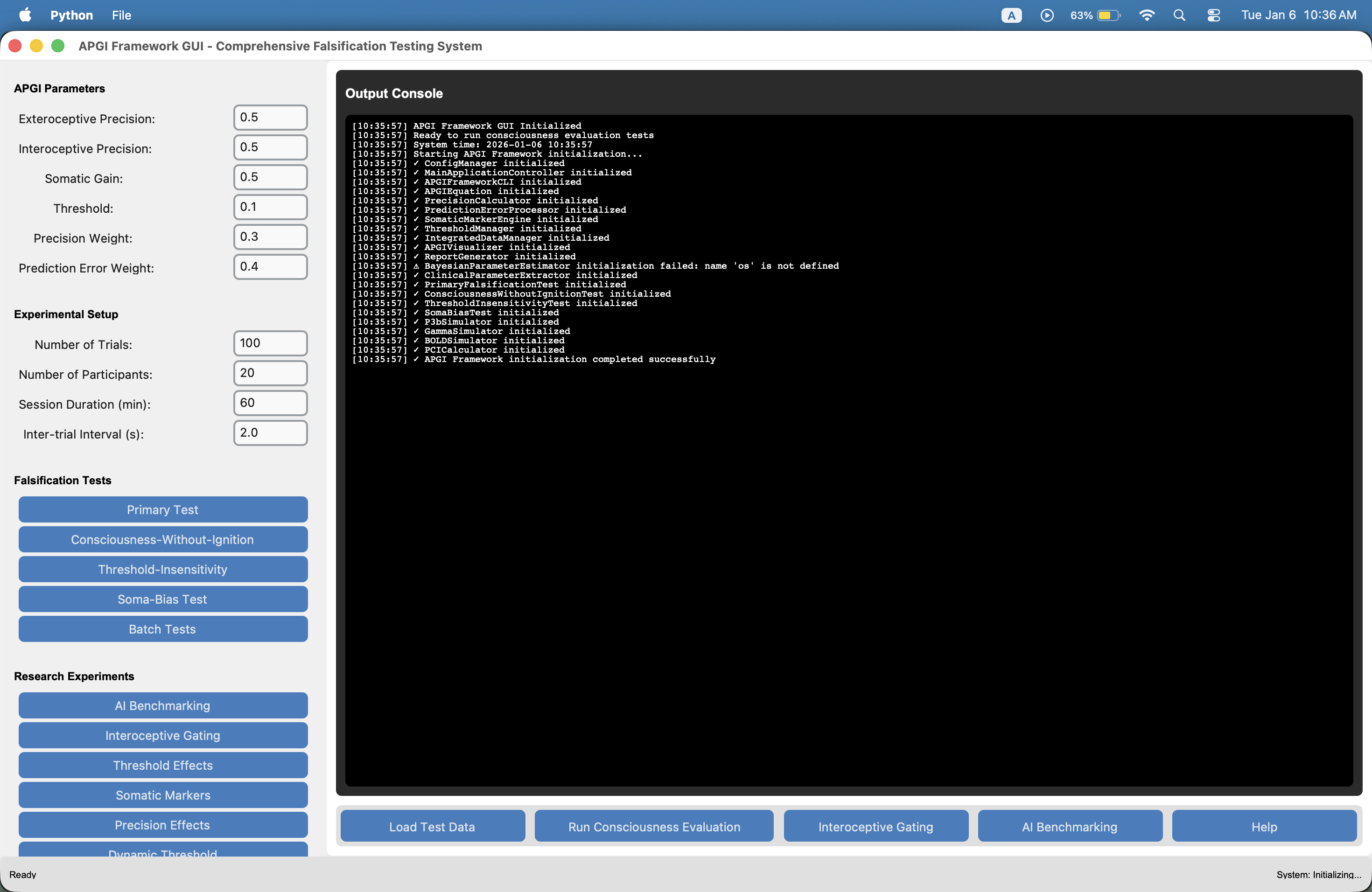
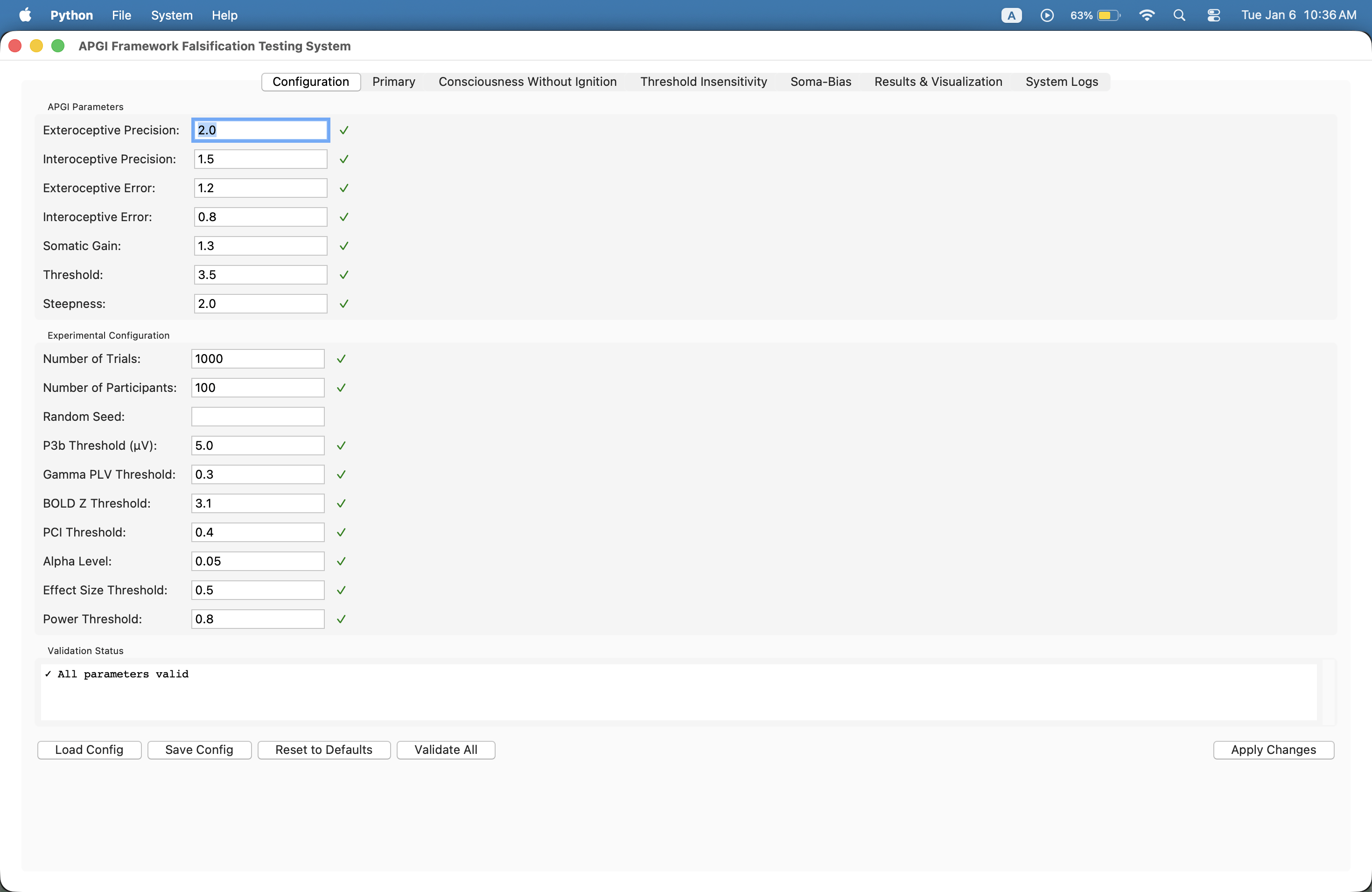
Access via command-line, GUI, or programmatic API. Tkinter-based interface with parameter configuration and real-time logging.
Core Architecture
Four fundamental computational models driving consciousness research
Dynamic Threshold
Adaptive ignition threshold mechanism for conscious access. Gates information flow based on interoceptive precision and prediction error magnitude.
Precision Weighting
Precision-weighted prediction errors that modulate sensory processing. Determines confidence in interoceptive vs exteroceptive signals.
Prediction Errors
Hierarchical prediction error signals across multiple timescales. Drives learning and conscious awareness through surprise minimization.
Free Energy
Expected free energy calculations for decision making. Balances epistemic value (information gain) with pragmatic value (goal achievement).
Implemented Experiment Paradigms
Simulated versions of published experimental designs. They have not been validated against human data.
Interoceptive Gating Paradigm
Tests how interoceptive precision gates conscious access through cardiac discrimination tasks.
- Three conditions: interoceptive focus, exteroceptive focus, control
- Threshold tracking and detection rate analysis
- Simulates heartbeat detection accuracy
- Validates precision-gating hypothesis
python run_experiments.py interoceptive_gating \

                --n_participants 20 --n_trials 100
AI Agent Benchmarking
Compares different agent architectures in survival environments with multiple performance metrics.
- Tests Random, Reactive, DQN, and APGI agents
- Grid world with food, obstacles, and predators
- Metrics: survival time, energy efficiency, food consumption
- Demonstrates APGI advantages in complex environments
python run_experiments.py ai_benchmarking \

                --n_episodes 100 --n_agents_per_type 3
Comprehensive Documentation
Everything you need to get started and contribute
Quick Start Guide
Get up and running in 5 minutes with installation, validation, and first experiments
GUI Visual Guide
Complete visual walkthrough of the graphical interface with screenshots
User Manual
Complete reference covering all features, commands, and use cases
CLI Reference
Command-line interface documentation with examples and parameter descriptions
Results Interpretation
Guide to understanding test results, statistical metrics, and falsification criteria
Troubleshooting
Common issues, solutions, and debugging strategies for smooth operation
Start Building with APGI
Clone the repository and run your first consciousness model in minutes
git clone https://github.com/lesoto/apgi-framework.git

              cd apgi-framework

              python -m venv venv

              source venv/bin/activate

              pip install -r requirements.txt

              python -m apgi_framework.cli validate-system