Computational Neuroscience Framework
APGI SYSTEM
Allostatic Precision-Gated Ignition
A computational implementation of consciousness based on active inference, predictive processing, and allostatic regulation. Designed to model human-like cognitive processes through biologically-inspired architectures.
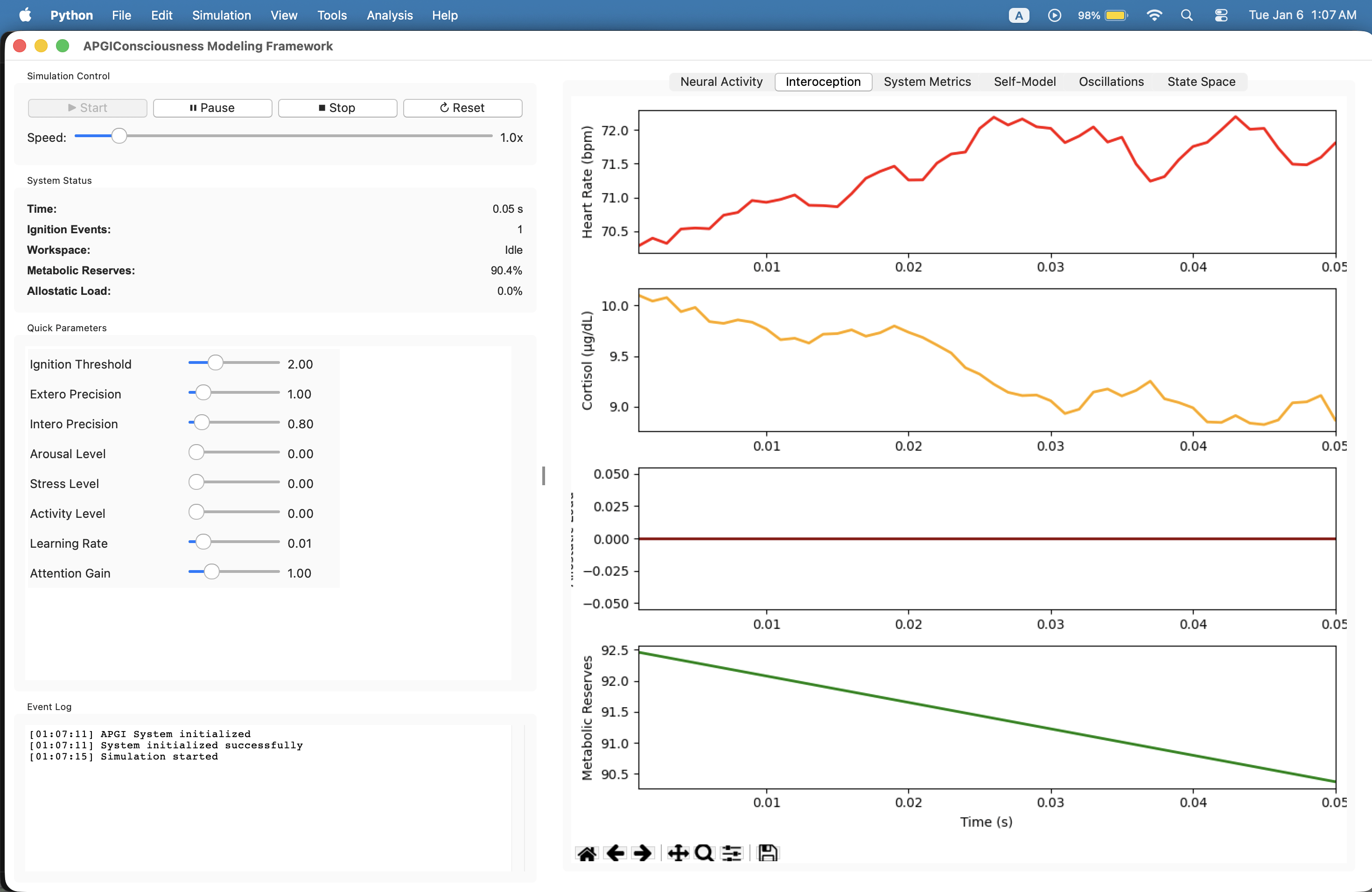
Framework Overview
Core Concept
APGI integrates multiple theoretical frameworks to create a comprehensive model of consciousness and cognitive processing. It implements biologically plausible mechanisms for perception, attention, decision-making, and self-awareness.
Research Applications
- • Attentional blink and perceptual limitations
- • Change blindness and visual awareness
- • Decision-making under uncertainty (Iowa Gambling)
- • Binocular rivalry and competitive perception
- • Somatic marker hypothesis validation
System Architecture
Core Systems
- • Active Inference Engine
- • Hierarchical Predictor
- • Precision Weighting
- • Free Energy Calculator
Neural Systems
- • Microscale Networks
- • Mesoscale Columns
- • Macroscale Networks
- • Neural Oscillations
Interoception
- • Body Model
- • Allostatic Regulator
- • Somatic Marker System
- • Physiological States
Ignition Dynamics
- • Ignition Threshold
- • Global Workspace
- • Temporal Dynamics
- • Information Broadcasting
Self-Model
- • Minimal Self
- • Narrative Self
- • Coherence Maintenance
- • Autobiographical Memory
Thermodynamic
- • Metabolic Budget
- • Energy Constraints
- • Entropy Tracking
- • Thermodynamic Costs
Core Subsystems
Active Inference Engine
Implements variational free energy minimization and Bayesian inference through hierarchical predictive coding across 4 levels.
Allostatic Regulation
Models physiological states and maintains homeostatic balance through interoceptive predictive processing.
Ignition Dynamics
Implements global workspace broadcasting with threshold-based ignition events following 300-500ms timeline of consciousness.
Self-Model System
Maintains minimal and narrative self-representations with coherence tracking and integrity monitoring.
Experimental Tasks
Attentional Blink
Tests temporal attention limitations and consciousness timing through rapid serial visual presentation.
Change Blindness
Examines visual perception failures when changes occur during saccades or brief interruptions.
Binocular Rivalry
Studies competitive perception when different images are presented to each eye simultaneously.
Iowa Gambling Task
Assesses decision-making under uncertainty and somatic marker hypothesis in risky choices.
Masking Paradigm
Tests subliminal processing and threshold detection for conscious vs. unconscious perception.
Validation Metrics
Comprehensive metrics including Phi integration, PCI complexity, and coherence tracking.
GUI Interface
Control Panel
- • Start/Pause/Stop/Reset controls
- • Speed control (0.1x - 10x)
- • System status display
- • Quick parameter adjustments
- • Event log with timestamps
Visualization Tabs
- 1. Neural Activity
- 2. Interoception
- 3. System Metrics
- 4. Self-Model
- 5. Oscillations
- 6. State Space (3D)
Menu System
- • File Menu (8 items)
- • Edit Menu (4 items)
- • Simulation Menu (5 items)
- • View Menu (7 items)
- • Tools Menu (6 items)
- • Analysis Menu (5 items)
- • Help Menu (3 items)
Keyboard Shortcuts
Data Export
Design Targets and Success Criteria
These are design goals for the simulation software. They are not validation results, and no claim is made that they have been met.
Success Criteria (Goals)
- • Ignition dynamics match 300-500ms timeline
- • Metabolic costs align with 5-10% overhead
- • Reproduces attentional blink phenomena
- • Reproduces masking paradigm effects
- • Human-comparable task performance
- • Neural signatures match empirical data
- • Models of altered states are compared with published findings
- • Scalable to large-scale brain simulations